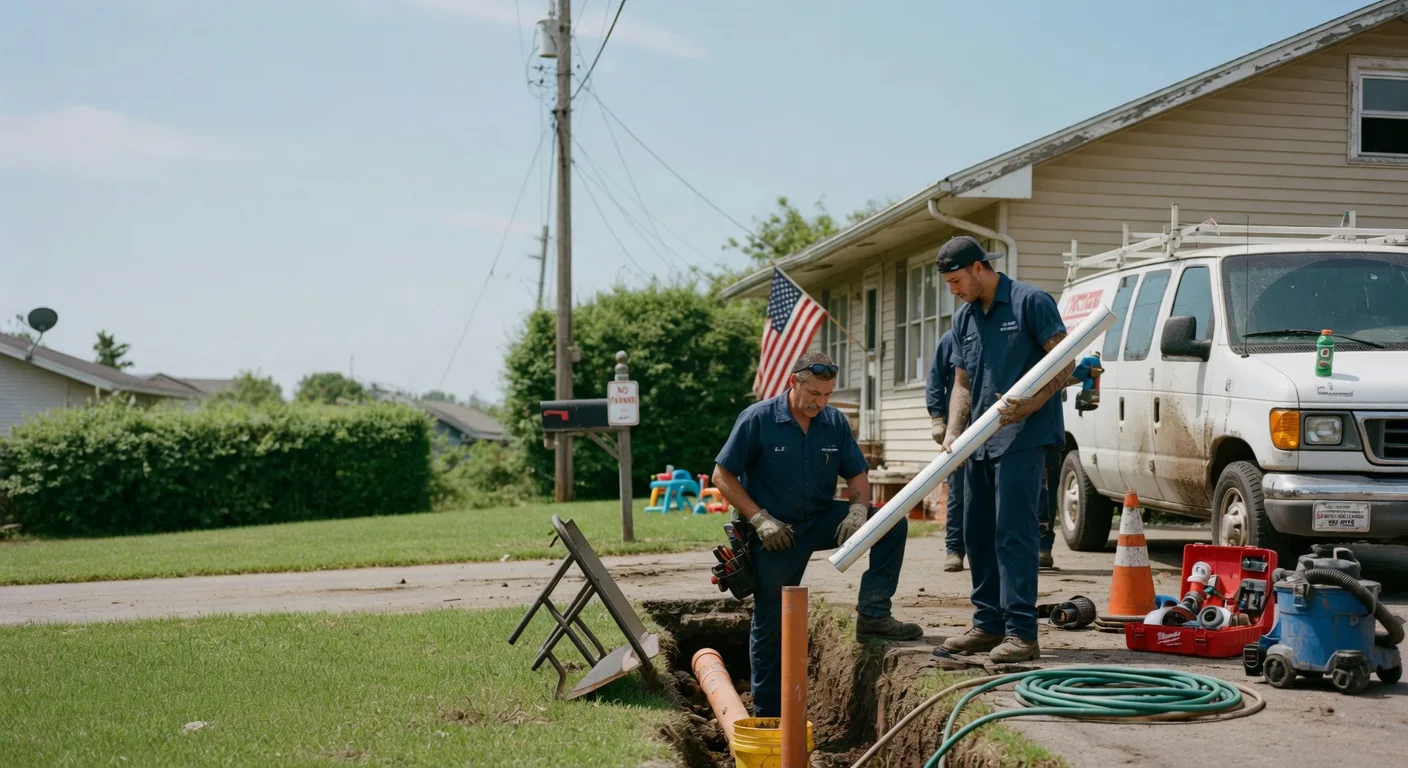
What is the difference between a septic system and a city sewer line for drain problems?
The two systems fail in different places, so the first job is knowing which one your home has. A city sewer line carries wastewater from your house to a municipal main, so trouble is usually confined to the pipe: roots at a clay joint, a bellied section, scale in old cast iron, or a blockage in the lateral. Every drain in the house backing up at once typically means the private line or the connection at the street. A septic system adds a buried tank and a drain field. Solids settle in the tank, and liquid flows out through perforated pipe into the soil. Slow drains or backups can mean a tank that is full and overdue for pumping, a clogged outlet filter or baffle, a failing drain field that can no longer absorb water, or a blockage in the short line between the house and the tank. Soggy ground or a strong odor over the tank area points away from the house plumbing. A cable machine or hydro jetting can clear the house line on either system, but jetting into a septic line needs care about where the water and debris end up. Property paperwork, a cleanout location, or the water utility can tell you which system you have. Expert Plumbers Co connects homeowners with an independent local plumber who works on that type of system.
Homeowners often assume a septic problem and a city sewer problem look the same from the bathroom, but there are a few quick clues. On city sewer, a backup after heavy use is usually the private line or the lateral at the street, and neighbors on the same main may have had the same trouble. On septic, the problem tends to build slowly: drains slow down across the house, the toilet flushes weakly, and a patch of lawn stays wet or unusually green. A common mistake is pouring additives into a septic tank hoping to fix a failing drain field. They do not repair soil that has stopped absorbing water. When you call, tell the plumber how old the system is, when the tank was last opened, and where the cleanout or lid sits. In older homes the tank may be buried deeper than expected and need to be located first, which adds time before any repair starts.
What causes scale build-up inside old cast iron drain pipes?
Scale in cast iron is rust and mineral deposit growing on the inside wall of the pipe. Cast iron corrodes from the inside over decades. The rust forms rough lumps, called tubercles, and minerals carried in the water settle on them. Grease, soap residue and paper then catch on that rough surface and the bore gets smaller.
The homeowner sees it as drains that slow down over time, often more than one fixture at once, and gurgling when a tub or washer empties. The pipe can look fine from outside while the opening inside has shrunk to a fraction of its size.
A cable machine will punch a hole through the scale, but the water often keeps running through a narrow channel and the build-up returns. Hydro jetting strips the wall back much more completely. Before either one, a camera inspection is worth having on old iron. It shows how much scale there is and whether the pipe wall is thin, cracked or flaking, because a line that is weak can fail once the scale holding it together is cleaned off.
What the job costs depends on access, the pipe material involved, how much has to be opened up or removed, and any permit or code requirement. If sewage is backing up into the house, stop running water and call. Expert Plumbers Co is a referral service. We refer you to a local plumber for Drain Cleaning or Emergency Drain Cleaning in Browns Valley, CA: (380) 262-9173.
A point many people miss is that cleaning scale is not always the end of the story. Once the wall is stripped back, the bare iron can start rusting again, so the line may need cleaning more than once over the years if the pipe is not replaced. Another sign it is getting worse is rusty or dark water standing in a drain that used to run clear, or small flakes of rust in a trap. In homes built before plastic pipe became common, a camera also shows whether the line is worth keeping or is near the end of its life. Pipes that are thin or cracked may need a section replaced, and that can be done in stages rather than all at once. When you call, mention the age of the house and any previous repairs to the drains, since patches in old iron often use different materials.
We just built or remodeled and the drains are already slow. Why?
The plumbing is new, and the tub drains like an old one. Or the sink gurgles whenever the washer runs. New work should not do this, and the cause is usually in how the pipe was set.
Four causes come up. First, not enough fall on a horizontal run. Water needs slope to carry solids, and a flat run leaves them behind. Second, a vent that was never tied in or was capped. The line cannot breathe, so you get gurgling and slow flow with no clog. Third, construction debris left in the line: grout, drywall mud, thinset, sand. It sets hard on the pipe wall. Fourth, a trap arm run too long.
One slow fixture points to its own trap arm, slope or vent. Several fixtures slow together, or the lowest drain backing up, points to the main run, a debris plug or a vent problem.
Safe homeowner check: note which fixtures are slow and listen for gurgling. Do not climb onto the roof. Stop running water and call now if water or sewage comes up in a tub or floor drain.
A camera inspection is the right first step on new work. It shows a flat section, a ridge of hardened material on the pipe wall, or a vent that never connected. Repeat cabling just pokes a hole through the problem, and it returns. A cable machine is enough for a soft, loose blockage. Hardened cementitious debris often needs hydro jetting. Slope and vent faults need the piping corrected, and what that involves follows access, materials, how much has to be opened up, and any permit or inspection.
Expert Plumbers Co is a referral service. We refer homeowners in Browns Valley, CA to an independent local plumber for Drain Cleaning and Emergency Drain Cleaning. Call (380) 262-9173.
Keep a record while the work is fresh. Photograph any open walls or trenches before they are closed, and write down the date the slow drains first showed up. If a builder or remodeling contractor did the work, the fault may be theirs to answer for. A written note from the plumber describing what the camera found, such as a flat section or hardened debris, helps far more than a general complaint.
Tell the plumber when the work finished, which fixtures were added and whether the main line was touched.
A common mistake is pouring strong drain chemicals into a new line. They rarely touch hardened grout or thinset, they can damage fittings, and they make later cabling or jetting unsafe for whoever handles it. Another is waiting for the problem to settle. Construction debris does not wash away. Ask whether any air admittance valves were used in place of a full vent, and whether local code allows them.
Water comes up in my bathtub when the shower or the sink next to it is running. What does that mean?
When water appears in the tub while another fixture runs, the drain water has nowhere to go and is finding the lowest open drain in the bathroom, which is usually the tub. It means the shared drain line past those fixtures is restricted. It is not a tub problem.
The tub drain sits low and connects to the same branch as the sink and often the toilet. If a clog, a bellied pipe holding water, or roots at a joint slows that branch, the extra flow from the sink backs up through the tub drain. A tub that gurgles or burps is showing you the same thing.
The timing tells you something. If it happens only when the sink runs, the blockage may be in that shared branch. If it also happens when the washing machine or a toilet elsewhere in the house is used, the main drain is the likelier suspect, and the whole line is slowing down.
Safe checks you can do: run the sink alone and watch the tub, then run the shower alone and watch the sink. Check whether a basement floor drain or other low drain shows water too. Pull the tub stopper or strainer and clear any hair. Do not keep running water to see how bad it gets, and do not use chemical cleaner in a drain that is already backing up, since the liquid can come back up to your skin.
A cable machine often clears a soft clog in a branch line. If the backup returns, it needs a camera inspection to show whether roots, a bellied section, or a damaged joint is behind it, and hydro jetting may be the next step for grease or heavy buildup on the pipe wall.
Stop running water and call right away if the water in the tub is dark or smells like sewage, if it rises when you flush, or if other drains in the house are slow. That points to the main sewer line, and wastewater is a health risk. Keep children and pets out of the bathroom.
Cost depends on access, how far the blockage sits, whether a cleanout is available, and how much has to be opened or replaced.
Expert Plumbers Co can connect you with an independent local plumber in Browns Valley, CA when you call (380) 262-9173.
The furnace or air conditioner drains into my basement floor drain and now it overflows. Is that a drain cleaning job?
"The furnace drains into my basement floor drain and now it overflows." That is a common one, and it is a drain problem with two parts. The overflow can come from either end: the small condensate line, or the floor drain it empties into.
Condensate lines clog with algae and sludge. Once it blocks, water backs up at the unit or spills from the line onto the floor. Many systems also have a trap on that line, and the trap is the first place sludge collects.
The floor drain itself can be the problem. If it is slow or backs up when you run the washer or a tub upstairs, the cause is in the house drain: grease build-up, a bellied line holding water, or root intrusion at a clay joint further out.
One slow floor drain, with the rest of the house draining fine, usually means a local blockage in that branch. Every drain in the house backing up, or the lowest drain gurgling and rising while others run, points to the main line or a failed sewer lateral.
Safe homeowner check: Look at the pipe from the unit. Is water standing in the pan or trap? Pour a bucket of water into the floor drain and watch how fast it goes. Do not pour bleach or drain chemicals into the condensate line without knowing the unit's instructions.
Stop running water and call now if the floor drain is bringing up sewage or a sewer smell, other drains in the house are slow or gurgling, water is spreading toward electrical equipment or the furnace, or the overflow comes back soon after you clear it.
A cable machine is often enough for a plain clog in the floor drain branch. A condensate line is a different job: it needs flushing or clearing at the line and trap, and may need a cleanout fitting added. If the floor drain keeps backing up, a camera inspection shows whether the main line has roots or a belly. Hydro jetting is used when grease or scale coats the pipe wall.
Expert Plumbers Co is a referral service. We connect you with an independent local plumber in Browns Valley, CA. Call (380) 262-9173.
Ask the plumber to check both the condensate line and the floor drain, and to explain which one failed. Ask whether the condensate should drain somewhere else, since rules vary by area on where it may discharge. Cost depends on access, the parts needed, how much has to be opened up or removed, and any permit or code requirement.